







Sustainability Across the iGaming Industry

The iGaming industry is going through a period of considerable transformation. A sector once measured almost entirely by its entertainment offering and pace of expansion is now being fundamentally reoriented around a priority that can no longer be ignored: sustainability.
For iGaming businesses, sustainability has outgrown its earlier role as a corporate social responsibility (CSR) exercise or a consumer-facing marketing concept. It has embedded itself into the core of business strategy, shaping decisions around environmental footprint, player protection, and how companies communicate with their audiences.
As competition across global markets intensifies and the pace of technological change shows no sign of slowing, operators throughout the industry are rethinking how they run their businesses – not purely in pursuit of growth, but with a genuine commitment to supporting both society and the environment. This article looks at how sustainable iGaming is completing its evolution from an abstract idea into a working operational framework, one that supports lasting business stability and responsible leadership.
Key Drivers Behind the Change
Several converging forces are pushing the iGaming industry toward more sustainable ways of operating.
The first is the growing intensity of competition in the global gambling market. As products and services across the sector align with high industry standards, operators find it increasingly challenging to differentiate their brands through functional capabilities alone. For a new generation of socially aware players and customers, a company’s ethical standing and sustainability credentials have become meaningful factors in where they choose to spend their time and money.
The second force is technological progress, which presents the industry with both a challenge and an opportunity. The ever-growing data demands of modern gaming platforms place significant upward pressure on energy consumption. At the same time, advances in artificial intelligence and cloud computing are equipping operators with powerful new tools for tracking their environmental impact and building more effective player protection systems.
The third driver is the shifting expectations of investors and stakeholders, which have now reached a point where they can no longer be treated as secondary considerations. Institutional investors are applying environmental, social, and governance (ESG) criteria with increasing rigour when assessing a company’s risk profile and long-term prospects. While no dedicated environmental legislation exists specifically for iGaming, broader initiatives such as the EU’s Corporate Sustainability Reporting Directive (CSRD) and the Energy Efficiency Directive (EED) are already leaving a visible mark on how the sector operates and plans for the future.
Three Core Pillars of iGaming Sustainability
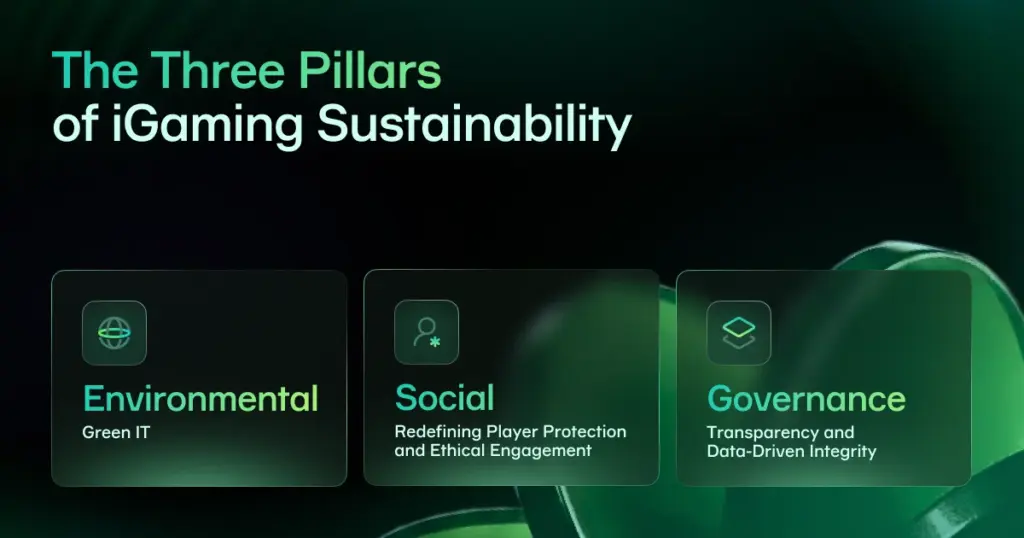
Sustainability in iGaming is commonly examined through the ESG framework, which brings together environmental, social, and governance principles.
Environmental Sustainability: Green IT
The environmental consequences of online gambling are frequently underestimated, largely because they lack the physical visibility associated with traditional land-based casinos. Bricks-and-mortar venues have an obvious resource footprint – lighting, heating, and physical waste are all plain to see. The ecological impact of iGaming, by contrast, is largely invisible, embedded within vast networks of servers and data centres running continuously behind the scenes.
As demand for high-definition streaming and real-time data processing continues to climb, the energy needed to sustain these services grows alongside it. In response, the industry is placing increasing weight on green IT as a central pillar of its broader sustainability efforts.
Social Dimension: Rethinking Player Protection and Ethical Engagement
Within the sustainability framework, the social component is widely regarded as the most consequential for the long-term health of the industry. Where environmental initiatives are focused on protecting the planet, social initiatives are focused on protecting the people at the heart of the business: the players themselves.
A sustainable iGaming industry is one where entertainment does not come at a cost to player wellbeing. This understanding has driven operators away from reactive safety measures and toward proactive responsible gaming systems built directly into the user experience.
Social sustainability also reaches inward, shaping internal company culture through diversity, equity, and inclusion programmes, as well as meaningful participation in community initiatives. These commitments strengthen brand credibility and help build lasting trust among players, partners, and stakeholders alike.
Governance: Data-Driven Transparency and Integrity
In the context of sustainable iGaming, governance has evolved from a basic licensing exercise into a foundational element of business stability. Where environmental and social efforts address the impact a company has on the world around it, governance ensures that those efforts are properly measured, openly communicated, and held to account.
For operators navigating today’s market, transparency sits at the centre of how trust is built – with oversight bodies, with investors, and with players.
By 2026, ESG reporting and structured internal policies have become standard practice among leading operators across the industry.
Through annual sustainability reports, operators put concrete figures behind their ESG commitments – covering areas such as gender pay equality, reductions in carbon emissions, and the measurable effectiveness of responsible gaming frameworks. This level of openness carries growing importance for investors, who increasingly lean on ESG indicators when forming a view of a company’s long-term financial risk and sustainability.
Soft2Bet and Sustainable Development
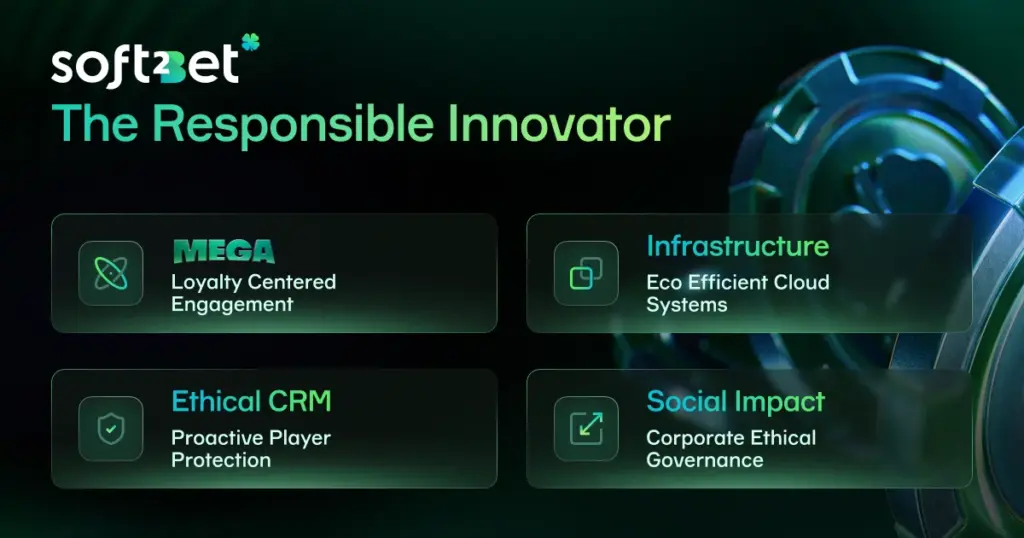
Soft2Bet positions itself within the industry as a responsible innovator, weaving sustainability principles into several core areas of how the business operates.
- Motivational Engineering Gaming Application (MEGA): The MEGA platform serves as a gamification engine built to deepen long-term player engagement. Rather than leaning on bonus-heavy marketing campaigns to drive activity, the system is designed around sustainable interaction models that prioritise lasting user participation over short-term incentives.
- Cloud-based infrastructure: The company’s move to cloud-based infrastructure has helped bring energy consumption down while keeping technical performance at a high level. This demonstrates that sophisticated technology and improved environmental efficiency are not mutually exclusive.
- Responsible gambling through ethical CRM: Soft2Bet applies customer relationship management tools backed by data analysis to identify potentially harmful behavioural patterns at an early stage. This enables the company to shift from reacting to problems after they arise toward actively protecting players before issues escalate.
- Social responsibility: The company’s sustainability commitments extend beyond the platform itself, encompassing social initiatives and charitable contributions that reflect broader organisational values around ethical conduct and inclusion.
The Current Legal Framework
No single unified global environmental framework specifically targeting the iGaming industry currently exists. However, a combination of regional requirements and voluntary sustainability initiatives is gradually taking shape into a structure that operators need to take seriously.
For businesses operating in this space, the environment demands forward-thinking planning to ensure that infrastructure and operational models stay aligned with the direction that future oversight is heading.
EU Rules and the Energy Mandate
Operators active in European markets are aligning their operations with the EU Energy Efficiency Directive (EED). Originally designed with heavy industry in mind, the directive has since been extended to cover digital service providers as well.
From 2026 onward, data centres with an installed IT capacity of 500 kilowatts or more are required to submit detailed energy efficiency data to a central European database.
- Large iGaming platforms must therefore publish figures covering total energy consumption, power usage effectiveness (PUE), and even the water consumed by cooling systems.
- For companies headquartered within the EU, the Corporate Sustainability Reporting Directive (CSRD) introduces a further layer of obligation. Businesses must produce “double materiality” disclosures – accounting for both how sustainability factors affect their financial performance and how their digital operations produce broader environmental consequences.
In the absence of binding global standards, some licensing bodies have introduced voluntary frameworks to encourage responsible practices across the industry. Although participation remains optional, the framework gives licensed operators a structured way to report performance across 19 environmental, social, and governance indicators.
In practice, this initiative has grown into a meaningful industry benchmark. In many cases, holding this accreditation strengthens an operator’s position when competing for licence renewals or making a case for entry into new markets.
Industry trends point clearly toward sustainability requirements becoming mandatory components of licensing frameworks over time. Before the end of the decade, it is widely anticipated that environmental performance and sustainability track records will be assessed alongside established criteria such as Anti-Money Laundering (AML) and Know Your Customer (KYC) procedures.
- The sector may move toward a “green licensing” model in which operators are required to demonstrate credible carbon reduction targets or robust player protection frameworks as a standard part of their licensing obligations.
- For iGaming businesses, the strategic direction is becoming increasingly hard to ignore: build sustainability into operations now, or face steeper costs and greater exposure to licensing risk down the line – including potential financial penalties or restrictions on market access.
Conclusion
The path toward a sustainable iGaming future runs through the intersection of robust licensing systems, ongoing technological innovation, and genuinely ethical business practice.
For companies like Soft2Bet, this shift is already underway – with attention and investment moving toward player protection tools powered by advanced analytics and toward leaner, more energy-conscious technical infrastructure. As the broader legal landscape reaches a new stage of maturity, aligning environmental and social reporting with modern expectations, the operators that come out ahead will be those who have stopped thinking of sustainability as an unwelcome obligation and started treating it as one of the most reliable foundations for long-term innovation and trust.